
A new school year is starting across the UAE, and with it comes the annual question in most families about which activities are worth committing to. Music almost always makes the shortlist, and then almost as often gets dropped, because getting a child across Dubai to a music school on a weekday evening is a serious undertaking.
Online lessons solve that problem completely. Students in Dubai, Abu Dhabi, Sharjah and Al Ain now learn piano, keyboard and synthesizer from home, one-to-one, with a teacher of twenty years’ experience who works with both Western and Indian musical traditions. No traffic, no drop-off, no lost evening.
The UAE is an hour and a half behind Indian Standard Time, which puts UAE evenings squarely within a comfortable teaching schedule. An eight o’clock lesson in Dubai is a manageable evening slot in Kolkata, so families are not squeezed into odd hours or early mornings. Slots are also arranged around the Sunday to Thursday school week and around exam periods rather than fixed to one rigid timetable.
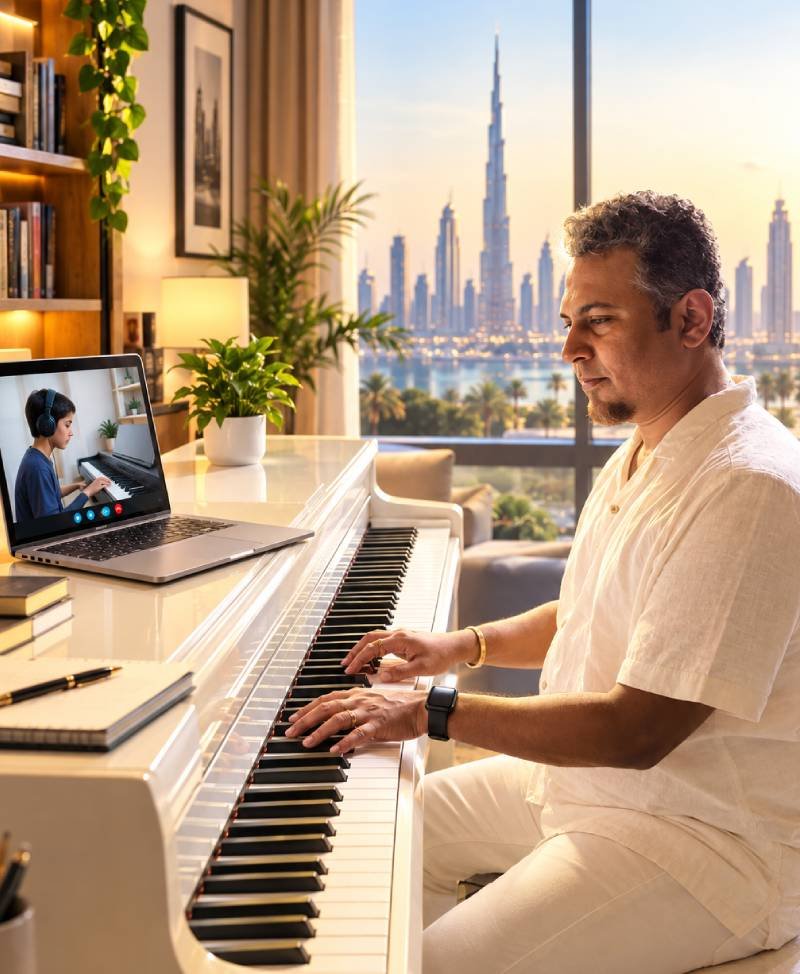
Group music classes move at the pace of the group. In a private online lesson, the whole session belongs to one student, which means mistakes get corrected the moment they appear rather than becoming habits. This matters enormously in the first year, when hand position and posture are still forming.
Expat families in the UAE travel often, for summer holidays, family visits and school breaks. Lessons that live on a laptop travel with you, so a month in India or Europe no longer means a month of lost progress and a difficult restart in September.
Students get a proper grounding in reading music, scales, technique and theory, with preparation available for ABRSM and Trinity College London examinations. This is the same syllabus your child’s school music department will recognise, which helps if they later take music as a subject.
The songs most students actually want to play. Learning film melodies alongside formal technique keeps motivation high, especially with teenagers, and teaches chord sense and ear training in a way that scales alone never will.
For Bengali families in the UAE, this is often the reason they call in the first place. Tagore’s songs, Bengali classical and Adhunik pieces are taught with proper notation, so children growing up far from Kolkata keep a real connection to the music their grandparents sing.
For Bengali families in the UAE, this is often the reason they call in the first place. Tagore’s songs, Bengali classical and Adhunik pieces are taught with proper notation, so children growing up far from Kolkata keep a real connection to the music their grandparents sing.
Parents new to online music lessons usually want to know whether a teacher can really see what the hands are doing. The answer is yes, with a small amount of setup that takes five minutes once.
You do not need an acoustic piano, and for most apartment living in Dubai or Sharjah you would not want one. A digital instrument is the sensible starting point.
Advice on a specific model within your budget is part of the first conversation, so nobody spends more than they need to.
Starting now, at the beginning of the academic year, gives a student the full run of terms one and two before examination pressure builds. Lesson frequency can be reduced during heavy exam weeks and picked up afterwards rather than abandoned altogether, which is usually what happens when a family has already committed to travelling to a physical school. Weekly lessons are the standard, and twice weekly is available for students working towards a grade.
The easiest way to know whether this suits your child or you is to try one session. Get in touch with the student’s age, any previous experience, and the times that work for your family in UAE hours, and a trial lesson will be arranged. Lessons run in English, Hindi and Bengali, whichever the student is most comfortable in.
Yes. Students across Dubai, Abu Dhabi, Sharjah, Ajman and Al Ain learn online, with lesson times set in UAE hours around the local school week.
Five years. Younger children start with very short sessions focused on rhythm, listening and simple hand shapes rather than formal reading.
Yes, and it is a large part of the teaching work. Several current students started after the age of fifty. Adults tend to progress quickly on theory and need patience with the physical side, so lessons are paced accordingly.
Yes. Preparation covers pieces, scales, sight-reading, aural tests and theory for all grades of both boards.
Start the conversation before you buy. For most beginners, a 61-key touch-sensitive keyboard is enough, while students aiming at graded exams are better served by an 88-key weighted instrument. Specific recommendations are given based on your budget.
Lessons continue online wherever you are, or pause and resume by arrangement. This is one of the main advantages of learning online rather than at a fixed location.