A synthesizer can feel like a cockpit. Rows of knobs, a screen full of patch names, and no obvious place to put your hands. Most beginners end up scrolling through presets instead of playing music. Synthesizer lessons for beginners fix that in the right order. First, you learn to play, then you learn to shape sound, and the knobs stop being decoration. These are live one-to-one classes with Sougata Bhattacharya, who has taught piano and synthesizer for 20 years, and they run across Europe over video.
Strip away the panel and a synth does four things. Once you know them, every synth you ever touch becomes readable.
You will build a simple patch from scratch in the first few weeks. After that, preset browsing becomes a choice rather than a hiding place.
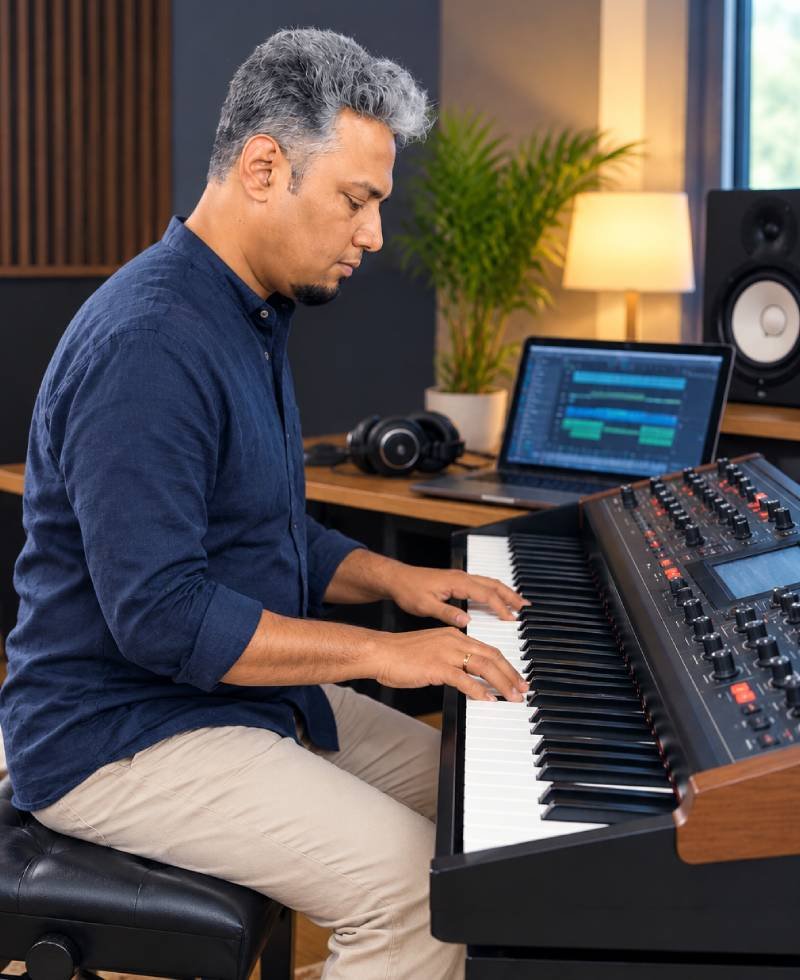
Sound design without playing ability gives you beautiful noises and no music. These lessons keep both moving together.
A good synth teacher is rarely around the corner, and in smaller cities there may be none at all.
You can start with very little, and you should not buy more until you know what you want.
|
Setup |
What it is |
Good for |
|
Entry keyboard with tones |
61-key arranger such as a Casio or Yamaha |
Learning to play, exploring sounds |
|
Hardware synth |
A small analogue or digital synth with real knobs |
Hands-on sound design |
|
MIDI controller plus laptop |
49 or 61 keys with software synths in a DAW |
The widest sound library at the lowest cost |
Any of the three works for lessons. Weighted or touch-sensitive keys help your technique, and headphones keep the peace in an apartment. Bring your shortlist to the first class before you spend anything.
Pace is set by your practice, not by a syllabus. Twenty focused minutes a day beats two hours on Sunday.
India is 4.5 hours ahead of UK time, 3.5 hours ahead of Central European Time and 2.5 hours ahead of Eastern European Time in winter. A 5:00 pm class in Berlin is 9:30 pm in Kolkata, so weekday evening and weekend slots are both workable. Tell us your city, and we will find a time that suits.
If you have a synth gathering dust, or you are about to buy your first one, start with guidance instead of guesswork. Synthesizer lessons for beginners are open now for students across Europe.
Book your first online synthesizer lesson.
Call or WhatsApp: +91 98754 60392
Email: contact@pianistsougata.com
Yes. Lessons start with playing basics and one simple patch, so no previous music or production experience is needed.
No. Keyboard technique is taught inside the synth lessons, so you build both at once.
Any of the three setups works. You can use a 61-key arranger keyboard, a small hardware synth, or a MIDI controller with software synths.
Yes. Software instruments teach the same oscillator, filter, and envelope controls, and cost far less to start with.
India is 3.5 hours ahead of CET, so European late-afternoon and evening slots work well. A 5:00 pm class in Berlin is 9:30 pm in Kolkata.
English, Hindi, and Bengali.
Call or WhatsApp +91 98754 60392, or email contact@pianistsougata.com.